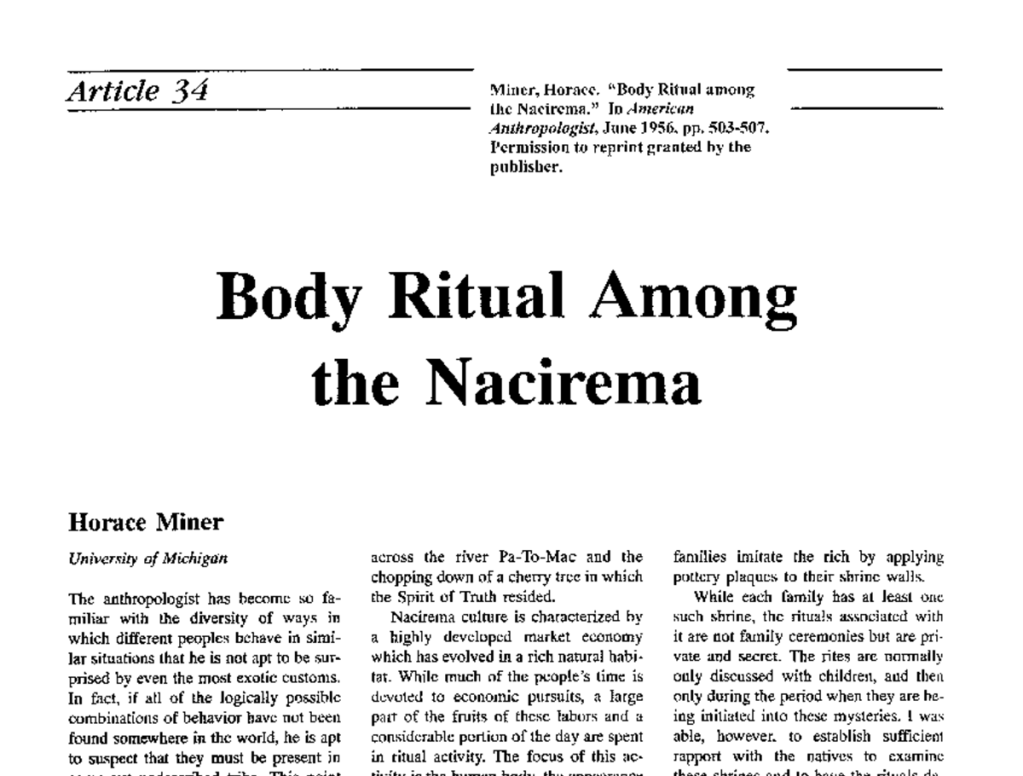
Today, I am going to examine the “Body Ritual Among the Nacirema,” a paper published in the American Anthropologist back in 1956, by Horace Miner. This paper, while perhaps unassuming at first glance, is one of the most influential and valuable works of cultural anthropology, especially for students first learning about the field, making it the perfect subject to write about for me.
In his paper, Miner wrote about a society, which he described as a mysterious North American tribe with some pretty bizarre customs. He starts off the paper by stating that they lived between the Canadian Cree, the various tribes of Mexico, and other Caribbean groups. What made them stand out was their strange obsession with their bodies and the weird daily rituals they performed. From the whole paper, it seems that it is a typical cultural study of a far-off, exotic society – except towards the end, you realize there’s a twist. Once you realize that “Nacirema” is just “American” spelled backwards, it all starts making sense. Miner was not actually studying some strange tribe at all; he is, in fact, describing regular American society, from an outsider’s perspective, to show how weird our normal habits can seem when you look at and describe them differently.
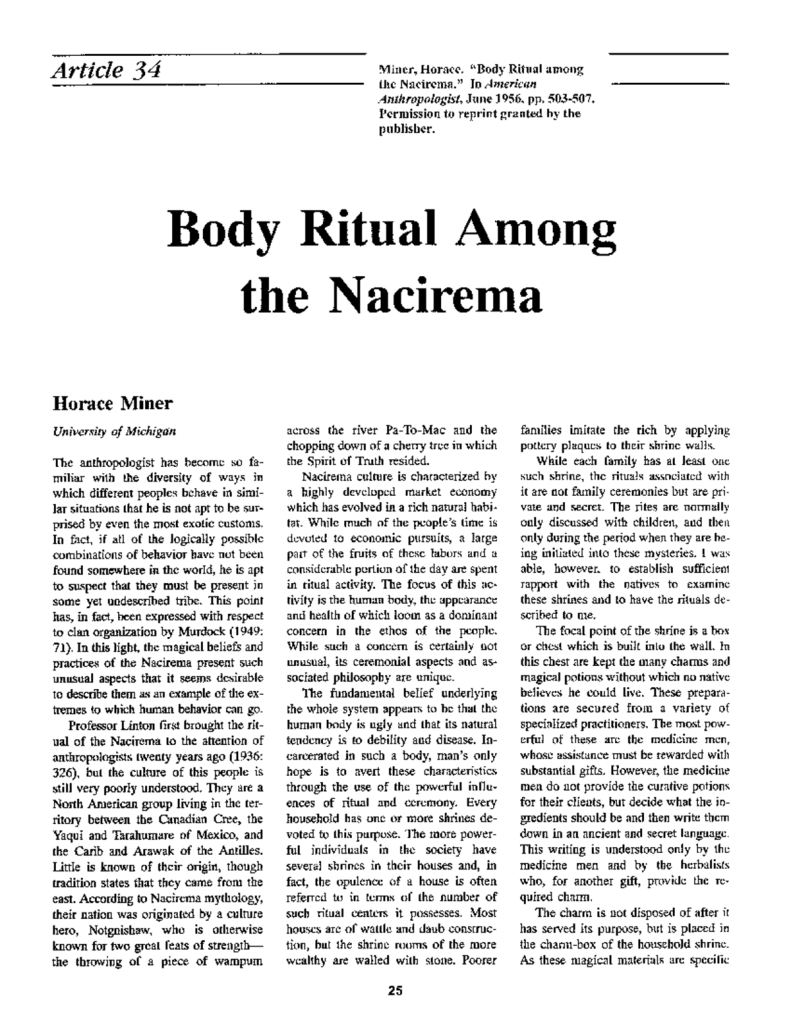
The genius of the article is how it completely changes your perspective on everyday life and makes you question all the papers or descriptions you have read in the past of cultures different from your own. For example, he describes Americans going to the bathroom, brushing their teeth, and visiting the doctor, but he uses diction to make them all sound like bizarre, magical rituals. He makes the reader show our own biases and how we can be so easily influenced solely by writing style. For example, he talks about the “mouth-rite” where people scrape their teeth with hog hairs and insert magical powders and pastes into their mouths multiple times per day. At first glance, you tend to think how strange that must be, but after realizing the true nature of the article, you might figure out that Miner is just describing brushing your teeth. He goes on to describe medicine cabinets as shrine boxes filled with magical potions, and doctors become “medicine men” who prescribe mysterious charms. By describing normal Western society behaviours in this exaggerated, ritualistic way, Miner forces us to see how strange our culture might look to someone who does not understand the context behind what we do.

The whole point of the article was to criticize how the majority of anthropologists of the time period studied other cultures, and in general, the way experts in the field represented their findings. Back in the 1950s, a lot of anthropological writing made other societies sound primitive and unnatural, with the main goal of comparing their different customs to those found in Western society. Scholar Mark Burde notes that the article remained one of the most downloaded anthropology papers decades after publication, mostly because of its delivery of such an important lesson. Miner essentially called out his own field for being ethnocentric – for judging other cultures by the standards we hold, rather than trying to truly understand them. When you describe the society we are surrounded by every day, described as having an obsession with body modification, visiting “holy mouth-men” for dental work, and performing daily cleaning rituals in special rooms, it becomes obvious how ridiculous it is to describe any culture in such a one-sided way. The article teaches us that the environment that may seem completely normal to us can be perceived as uncanny by others and vice versa.
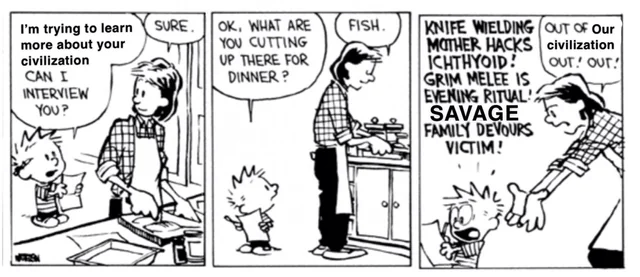
For students learning about anthropology, the Nacirema paper is immensely valuable because it teaches cultural relativism in a way that really sticks with you. It also teaches us how we can be influenced by both external and internal biases and how those biases impact our own opinions. Perhaps, in the future, we will not be as quick to judge or will do further research to confirm or disprove initial findings. Even today, we still tend to emphasize how “other” different cultures are from our own, both in media and in regular conversations. The Nacirema reminds us to check ourselves and approach unfamiliar cultures—and even our own culture—with curiosity and respect rather than judgment. That’s why the paper remains a staple in Intro to Anthro and why teachers still assign this article almost 70 years after it was written.
Sources
Miner, Horace. “Body Ritual Among the Nacirema.” American Anthropologist, vol. 58, no. 3, 1956, pp. 503-507.
“Nacirema.” Wikipedia, 17 Nov. 2025, en.wikipedia.org/wiki/Nacirema.
Burde, Mark. “The Long Life of the Nacirema.” JSTOR Daily, 3 Feb. 2023,
daily.jstor.org/the-long-life-of-the-nacirema/.
Nuwer, Rachel. “The Line Between Weirdness And Normalcy Depends Entirely on Your Point of View.” Smithsonian Magazine, 5 Feb. 2014, http://www.smithsonianmag.com/smart-news/1956-anthropologist-satirically-dubbed-america-land-pervasive-aversion-natural-body-180949657/.
 The New Anthropologist
Leave a comment