As part of my preparation for the AP English Language exam that I recently took, I learnt different idiomatic expressions and how to incorporate them into my writing. But what interested me the most was the apparent strangeness of some of them, which led me to wonder about where they started in the first place. If you’re stressed about finals week, you say that you’re going to “bite the bullet.” If your friend gives away a secret, you say that they “spilled the beans.” And if you are looking for an answer in the completely wrong place, you may say you’re “barking up the wrong tree.” But if you take a step back and look at these phrases literally, they sound completely insane. Why then do we use seemingly random events to express ourselves? Interestingly enough, I found out that these idiomatic expressions have a complex cultural anthropological perspective behind them. These idioms are basically linguistic fossils, or tiny pieces of history frozen in time, preserved by our daily speech even if the actual habits, technologies, or historical events that created them have completely vanished.
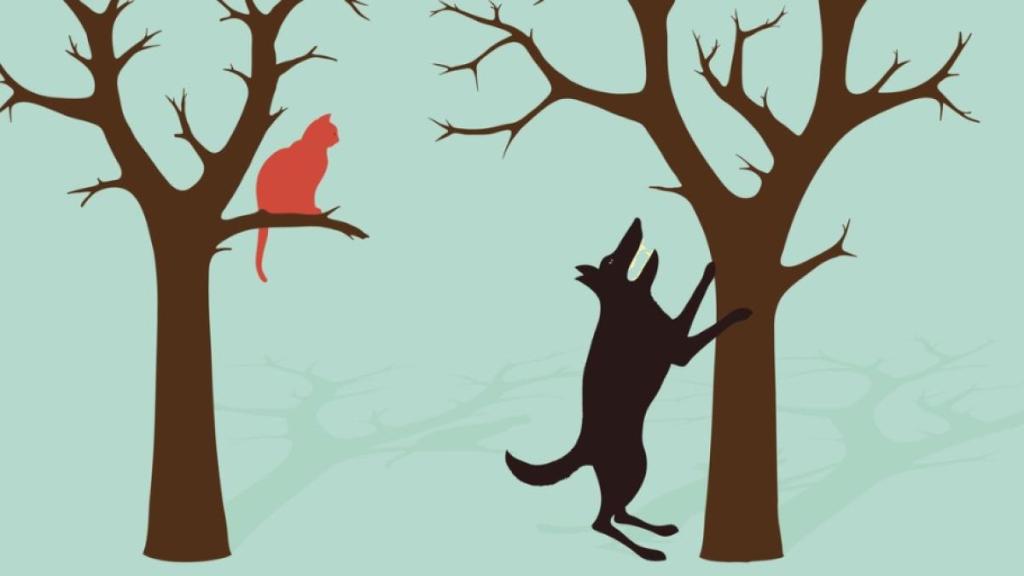
Take “barking up the wrong tree.” This phrase actually comes out of early American frontier life and colonial hunting practices. In those days, hunters relied heavily on trained hounds to chase prey, like raccoons, into the trees. If the prey managed to leap to a neighboring tree through the branches and escape while the dog kept howling at the base of the original trunk, the dog was literally barking up the wrong tree. Centuries later, the frontier and its hunting practices are almost gone, but we still use the language of hunting hounds when we make a wrong assumption or accuse the wrong person.
Another example of this phenomenon is “biting the bullet.” That phrase comes from old battlefield medicine before anesthesia existed. Wounded soldiers would literally be given a soft lead bullet to bite down on to cope with the extreme pain of surgery. Now, we use it to describe sitting down to face a tough exam or an awkward conversation.

Even “spilling the beans” has historical roots, and likely traces back to ancient Greek voting systems, where people dropped colored beans into a jar to cast their ballots anonymously. If the jar accidentally knocked over and the beans spilled, the secret results of the election were revealed too early, translating to revealing secrets too early in modern times.
Beyond just being cool trivia facts, it also made me wonder if our generation will leave behind phrases that will be used in future centuries that will make no sense then. Will teenagers say they need to “scroll past” an annoying situation or call fake people “NPCs” even if social media and video games look completely different to them?
Works Cited
Ammer, Christine. The American Heritage Dictionary of Idioms. Houghton Mifflin Harcourt, 2013.
Crystal, David. The Story of English in 100 Words. St. Martin’s Press, 2012.
Oliver, Jack. Linguistic Archaeology: How Expressions Survive History. Oxford University Press, 2018.

 The New Anthropologist
Leave a comment