We all like to think that we have no biases, especially when it comes to judging people, but whether you notice it or not, you probably have prejudices inside of you solely by listening to someone talk. The second someone starts talking, our brains start categorizing them and comparing them to past voices we have heard, and making assumptions on where they’re from, or how much money they have. This is a phenomenon that is what anthropologists call linguistic profiling, a term coined by Dr. John Baugh. Even though it is hard to admit to it, no matter how deep, the majority does have biases, both positive and negative, when it comes to accents. It’s pretty messed up when you realize that there is no such thing as a correct way to speak and that what we call “Standard English” is just the dialect of the people who have held the most power in recent history. We’ve been conditioned by our environment and media to think certain accents sound “smart” while others sound “uneducated,” which is an obvious myth that could have real-world consequences in people’s lives.

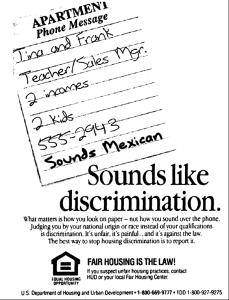
One such example of this is the research conducted by the aforementioned Dr. John Baugh. To see how deep linguistic profiling goes, he conducted a famous study where he called landlords to ask about apartment rental using three different accents:” Standard American, African American Vernacular English (AAVE), and Chicano English. Even though it was the same person making every call, and he kept the credentials consistent, he was consistently denied housing or told the apartment was unavailable only when he used a non-standard accent. This shows deep-rooted prejudice and how just hearing language can change the way we think about a person, showing the power of language.

At the end of the day, it’s wild how much weight we put on the way someone sounds when it’s just a reflection of where they grew up or who they spent time with. Looking at this through anthropology shows us that our idea of how to speak a “perfect” version of English is just a social construct and that every accent is just a different way, no one better than the other.
Work Cited
Lippi-Green, R. (2012). English with an Accent: Language, Ideology and Discrimination in the United States.
Baugh, J. (2003). Linguistic Profiling.
Purnell, T., Idsardi, W., & Baugh, J. (1999). Perceptual and Phonetic Experiments on American English Dialect Identification.
 The New Anthropologist
Leave a comment